Sewage cleanup works the same way everywhere in Canada: stop the water, record the damage, clear the line, remove what sewage ruined, disinfect and dry. What changes by city is who you call, where the owner's pipe ends, what a City crew will do and charge, and which subsidies exist. The guides below cover Toronto, Vancouver, Montréal, Calgary and Edmonton.
- The cleanup method does not change between cities; the phone numbers, ownership lines and subsidies do.
- Toronto, Calgary and Montréal route sewer problems through 311; Vancouver uses 3-1-1 with owner-only crew requests; Edmonton's utility is EPCOR.
- In every city covered here, cleaning up inside the home is the owner's responsibility.
- Subsidies pay for prevention, such as backwater valves, never for cleanup itself.
- HAUSE is an information and request network with no crews of its own in any city.
01 /Which city guides are available?
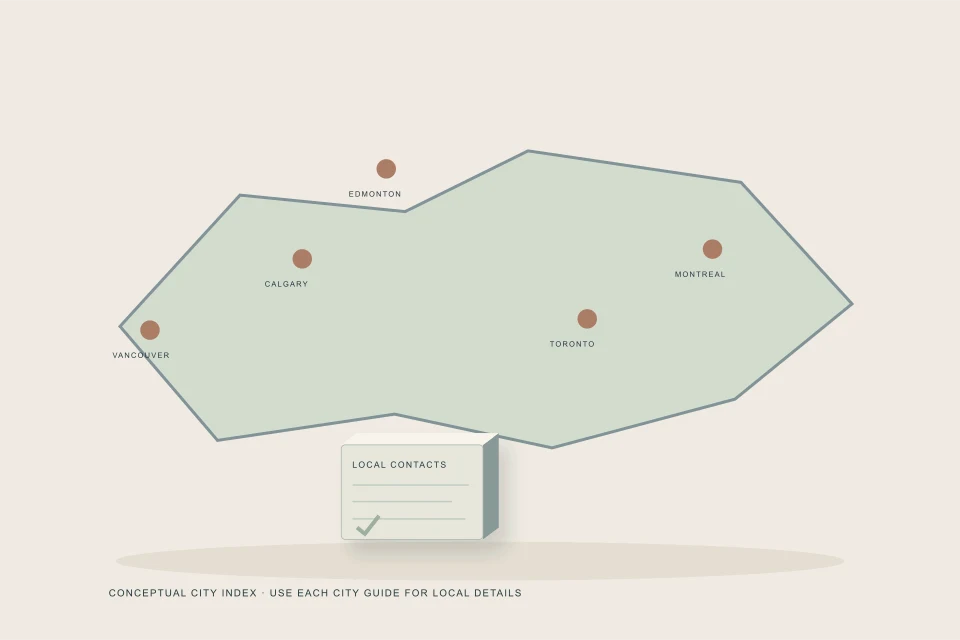
Five city guides are available, each built from that city's own published pages as checked September 2026. They keep the addresses of the original SewageCleanup.ca city pages, but the invented phone numbers, response times and testimonials those pages carried have been removed and replaced with verified local detail.
- Sewage backup cleanup in Toronto: 311 investigations, claims against the City, and the Basement Flooding Protection Subsidy Program.
- Sewage backup cleanup in Vancouver: the City's who-to-call guide, owner-only crew requests, cause-based charges and published fees.
- Sewage backup cleanup in Montréal: post-flood steps, the 50 cm drywall rule, bylaw 11-010 on backwater valves, RénoPlex and Rénoclimat.
- Sewage backup cleanup in Calgary: the City's three-step response, 311 triage, and what City crews will not do.
- Sewage backup cleanup in Edmonton: reporting to EPCOR, the property-line split, and EPCOR's backwater valve subsidy and home check.
02 /How do the five cities compare after a sewage backup?
The table summarizes the local differences that matter most during cleanup. Each entry comes from the city's or utility's own pages; the city guides give the detail and the source.
| City | Who to report to | Ownership line | Notable local rule | Prevention aid found |
|---|---|---|---|---|
| Toronto | 311 | City sanitary sewer under the road; private drain on the lot is the owner's | Claims for City infrastructure failure go to the City's adjusters | Basement Flooding Protection Subsidy Program |
| Vancouver | 3-1-1 or a plumber, depending on the problem | Owner responsible for what goes into the lateral, to and into the main | Charges follow the cause, not the location; only owners can request crews | None found on vancouver.ca |
| Montréal | 311 for a check of the City network | Owner's private connection; City network beyond | Bylaw 11-010 requires backwater valves | RénoPlex (City); Rénoclimat adaptation (Quebec, from October 1, 2026) |
| Calgary | 311 | City maintains public sewer; owner the service line and plumbing on the lot | Crews will not move furniture, lift carpet, remove toilets or cut drywall | None found on calgary.ca |
| Edmonton | EPCOR, 780-412-4500 | Owner to the property line, including the valve; EPCOR beyond | Fee if prohibited items caused the blockage; no reimbursement of private plumbers | EPCOR backwater valve subsidy and free home inspection |
“None found” means we did not find a program on the city's own website when we checked. It is not proof that none exists; ask your city's service line before deciding.
03 /What is the same in every Canadian city?
The cleanup itself is the same everywhere, because it follows the contamination, not the municipal boundary. Federal guidance from Health Canada and the Government of Canada's Get Prepared site applies across the country.
- Protect people and stop the water
Keep vulnerable people away, avoid wet electrical equipment, and stop all water use.
- Record the damage
Photos and notes before anything is moved; your insurer and, if relevant, your city will ask.
- Get the line cleared
A drain contractor for your side, the city or utility for theirs.
- Remove what sewage ruined
Carpet, underlay, lower drywall, insulation, soft furnishings and anything absorbent.
- Clean, disinfect and dry
Detergent first, then disinfectant on hard surfaces; the Get Prepared site says to clean up within 48 hours if possible to avoid mould.
Each step is covered in depth in the emergency guide, what to throw away, disinfecting after a sewage backup and drying and mould.
04 /What if your city is not listed?
If your city is not listed, find three things on its own website: how to report a sewer backup, where the owner's responsibility for the sewer connection ends, and whether it offers any flood-protection subsidy. Search the city's site for “sewer backup” or “basement flooding”; most larger Canadian municipalities publish a page with those words in the title.
| Question | Why it matters for cleanup | Where to look |
|---|---|---|
| Who do I call about a sewer backup? | Gets the right crew to the right part of the line | City website, 311 where available, or the water utility |
| Where does my part of the sewer connection end? | Decides who clears and who pays for the blockage | City or utility page on sewer service connections |
| Will the city charge for a service call? | Avoids a surprise bill on top of cleanup | Fees and charges page, or ask when you call |
| Can I claim against the city? | Some losses caused by public infrastructure may be claimable | Claims or risk management page |
| Is there a backwater valve or sump subsidy? | Helps pay for prevention after cleanup | Flood protection or rebate programs page |
Regional municipalities, counties and suburbs next to the big cities usually run their own programs. The former version of this site grouped places like Mississauga, Laval, Burnaby and Sherwood Park under their larger neighbours; the city guides now say plainly where a rule stops applying.
05 /How do tenants, condo owners and landlords fit into the city rules?
City rules are written for the property owner, so anyone else has to go through the owner or the building's manager. Vancouver states it outright: only a property owner can ask the City to send a sewer crew. Elsewhere the effect is similar, because the owner signs for charges, authorizes work and holds the insurance on the building.
- Tenants: report the backup to your landlord at once, in writing if you can, and photograph your own belongings. Contents are usually covered by your tenant policy, not the landlord's.
- Condo or strata owners: tell the property manager first. Common pipes and the building's policy are usually involved, and the corporation may appoint the cleanup company.
- Landlords: you are the one the city deals with. Arrange the line clearing, notify your insurer, and remember that tenants in a basement suite may need somewhere else to stay while sewage is cleaned up.
- Business tenants: check the lease for who handles plumbing emergencies and who insures the premises; the commercial cleanup guide covers downtime and access.
In any of these arrangements, keep your own photos and notes. When several parties are involved, the person with the clearest record usually has the easiest claim.
06 /Does SewageCleanup.ca have crews in these cities?
No. SewageCleanup.ca is part of HAUSE, an independent information and service-request network. It does not employ cleanup technicians, run a dispatch centre or maintain a network of partner companies in any city, and earlier claims about response times, certified local teams and insurance approval rates were not supportable and have been removed.
What it does offer is a way to describe your situation once. You can send a request with photos, the area affected and your city, and the HAUSE desk reviews it and follows up; any provider it suggests is independent and confirms its own availability. For deciding whether you need a professional at all, use the Sewage Cleanup Triage. For house and business cleanup scopes, see residential and commercial sewage cleanup.
FAQQuestions people ask
Which Canadian cities have a basement flooding subsidy?
Of the five cities covered here, Toronto's City program, Edmonton's EPCOR subsidy and Montréal's RénoPlex were found on official pages in September 2026. Quebec's Rénoclimat adds provincial aid from October 1, 2026.
Is 311 the right number for a sewer backup everywhere?
No. Toronto, Calgary and Montréal use 311, Vancouver uses 3-1-1 for some problems and a plumber for others, and Edmonton's drainage utility is EPCOR. Smaller places may use a public works line.
Does the city ever clean up a flooded basement?
In the five cities covered here, cleaning inside the home is the owner's job. A city may pay damages after a successful claim if its infrastructure failed, as Toronto's claims process describes.
Why were suburbs removed from the city pages?
Suburbs are separate municipalities with their own sewer rules, phone lines and programs. Listing them under a big city implied rules and coverage that do not apply.
NETWORKGo deeper across the HAUSE Sewer network
Sewer scope inspections in Edmonton: what to expect and who to call
Sewer scope and sewer line inspection in Edmonton: what mature and newer neighbourhoods show on camera, cold and clay soils, elms, EPCOR and 311 checks.
SewerCleaners.caWhere is my backwater valve? How to find it, recognize it and open the cover
Where is the backwater valve in a house? How to find it, what it looks like, what access box, sleeve and cover mean, how to open it safely, and valve alarms.
SewerQuotes.comSewer line replacement cost by city: why local quotes differ
Sewer line replacement cost by city: why Calgary, Edmonton, Regina and other Canadian markets quote differently, GST/HST by province, and local drivers.