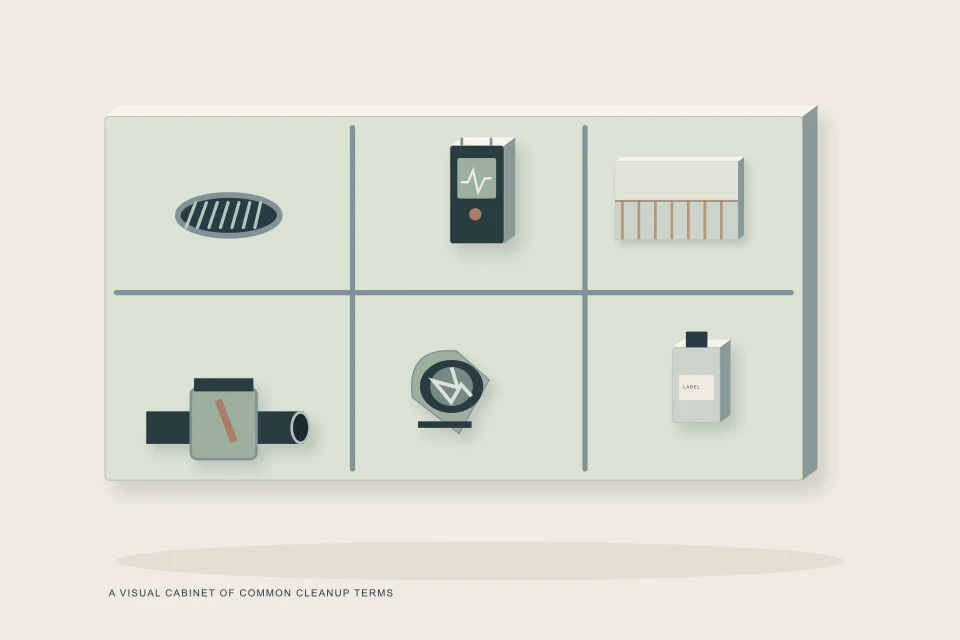
This glossary defines the words you will hear after a sewage backup, from restorers, insurance adjusters, plumbers and city staff. It covers water categories, cleanup and drying terms, drain and sewer parts, and claim vocabulary, each in one or two plain sentences, so you can read a scope, a policy or a city page with confidence.
- Black water, grey water and clean water describe how contaminated the water is, and they decide what must be removed.
- Mitigation and rebuild are the two phases of most cleanup jobs and are often separate invoices.
- The wick line, not the visible tide mark, sets how high wet drywall is cut.
- Endorsement, deductible and proof of loss are the insurance words that most affect what you are paid.
01 /How are the terms in this glossary grouped?
The terms are listed alphabetically below, but most fall into four groups. Knowing the group helps you tell which professional is using the word and why.
| Group | Who uses these words | Examples |
|---|---|---|
| Water and contamination | Restorers, public health | Black water, grey water, pathogen, wick line |
| Cleanup and drying | Restorers, contractors | Mitigation, extraction, air mover, moisture meter, containment |
| Drains and sewers | Plumbers, drain contractors, cities | Lateral, cleanout, backwater valve, surcharge, main |
| Insurance and claims | Brokers, adjusters | Endorsement, deductible, proof of loss, direction to pay |
For how these ideas fit together in practice, start with the sewage emergency guide and the sewage cleanup cost guide. Common questions are answered on the FAQ page.
A–ZTerms
- Additional living expenses
- Insurance coverage, where included, for extra costs such as a hotel and meals when a loss makes the home unlivable. Keep every receipt.
- Air mover
- A high-velocity fan that pushes air across wet surfaces to speed evaporation during structural drying.
- Backwater valve
- A valve on the building drain or a fixture drain that lets wastewater leave and closes when sewage flows back from the municipal sewer.
- Black water
- Grossly contaminated water such as sewage. Porous materials it soaks are normally removed rather than dried.
- Bottom plate
- The horizontal piece of lumber at the base of a stud wall. It sits in the wettest zone after a flood and must be cleaned and dried.
- Building drain
- The lowest horizontal drain pipe inside the building that collects waste from all fixtures and carries it to the sewer lateral.
- Category of water
- A restoration-industry classification of how contaminated water is. Sewage is treated as the most contaminated category.
- Clean water
- Water from a supply pipe, a water heater or rain that has not picked up contamination. It can often be dried in place if caught quickly.
- Cleaning
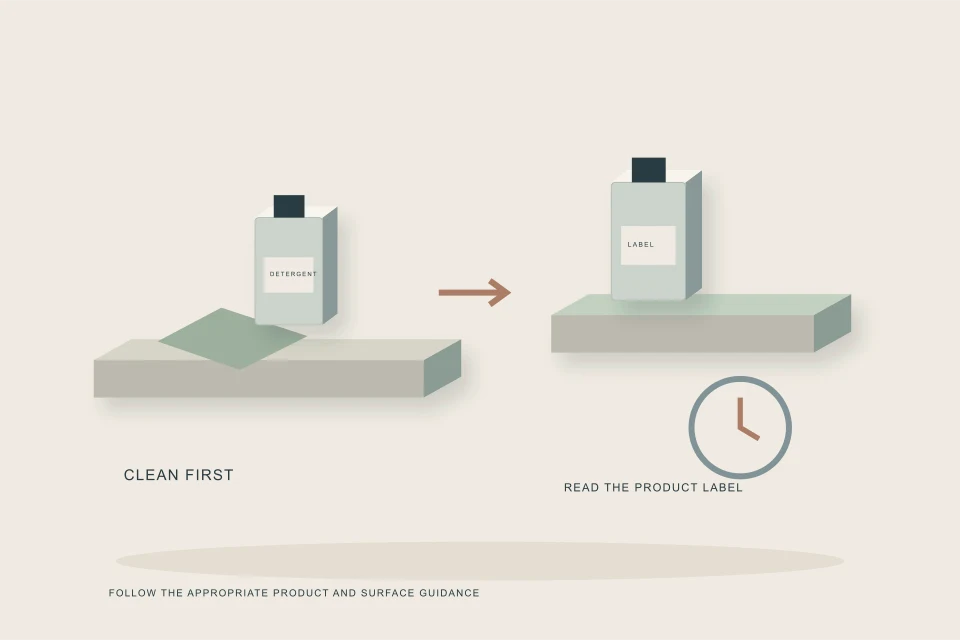
- Removing dirt, sludge and film from a surface with detergent and water. It always comes before disinfecting.
- Cleanout
- A capped access fitting on a drain or sewer line that lets a contractor or city crew reach the pipe without removing a fixture.
- Contact time
- How long a disinfectant must stay wet on a surface to work as its label claims.
- Containment
- Plastic barriers and controlled entry that keep contamination and dust inside the work area.
- Contents
- Belongings inside the home, such as furniture, clothing and electronics, as distinct from the building itself. Often a separate part of a claim.
- Deductible
- The part of an insured loss you pay before the insurer pays. Sewer backup endorsements sometimes carry their own deductible.
- Dehumidifier
- A machine that removes moisture from the air. Restorers use large refrigerant or desiccant units; household models are smaller.
- DIN
- Drug Identification Number, the eight-digit number that usually appears on the label of a disinfectant Health Canada has authorized.
- Direction to pay
- A form authorizing an insurer to pay a contractor directly. Read it before signing and ask your insurer.
- Disinfecting
- Applying a disinfectant to a cleaned surface to kill remaining germs, for the label's full contact time.
- Endorsement
- An optional add-on to an insurance policy. Sewer backup coverage is usually sold as an endorsement.
- Extraction
- Removing standing water and sludge with pumps and vacuums, the first physical step of cleanup.
- Floor drain
- The drain in a basement floor. As the lowest opening in most homes, it is usually where sewage appears first.
- Grey water
- Wastewater from washing machines, sinks or tubs without toilet waste. It still carries germs and can worsen if left standing.
- HEPA vacuum
- A vacuum with a high-efficiency particulate air filter, used on dry surfaces to capture fine dust and mould spores.
- Hydrogen sulphide
- A gas found in sewer gas that smells of rotten eggs at low levels and can deaden the sense of smell at high levels.
- Hygrometer
- A device that measures relative humidity in the air. Health Canada recommends keeping indoor humidity between 30 and 50 per cent.
- Lateral
- The private sewer pipe that carries wastewater from a building to the municipal sewer main.
- Main
- The municipal sewer pipe under the street or lane that collects flow from many laterals.
- Mitigation
- The first phase of a cleanup: stopping further damage through extraction, removal, cleaning and drying, before any rebuild.
- Moisture meter
- A pin or pinless instrument that reads moisture in wood, drywall or concrete, used to prove drying is complete.
- Mould remediation
- Removal of mould growth and affected materials, usually with containment and HEPA filtration. Needed when drying was too slow.
- N95 respirator
- A disposable mask that filters fine particles when properly fitted, recommended by Health Canada for flood and mould cleanup.
- Overland flooding
- Water entering a home from the surface, such as an overflowing river. Insured separately from sewer backup, where offered.
- Pack-out
- Removing contents from a damaged area for cleaning, storage or inventory during a restoration job.
- Pathogen
- A germ that can cause disease, such as some bacteria, viruses and parasites found in sewage.
- Porous material
- Material that absorbs water, such as carpet, drywall, insulation and particleboard. Sewage-soaked porous materials are usually discarded.
- Proof of loss
- The insurer's form listing damaged property and its value. The Insurance Bureau of Canada notes it is typically due within 30 days.
- Property line
- The legal boundary of a lot. Many cities split sewer responsibility near it, though the exact point varies.
- Rebuild
- The second phase of a cleanup: replacing insulation, drywall, flooring and finishes once the structure is clean and dry.
- Relative humidity
- The amount of moisture in the air compared with the maximum it can hold at that temperature, shown as a percentage.
- S500
- The ANSI/IICRC S500 standard, which describes procedures and precautions for professional water damage restoration.
- Sanitary sewer
- The municipal pipe system that carries wastewater from toilets, sinks and drains to treatment. Sewage backups come from this system.
- Scope of work
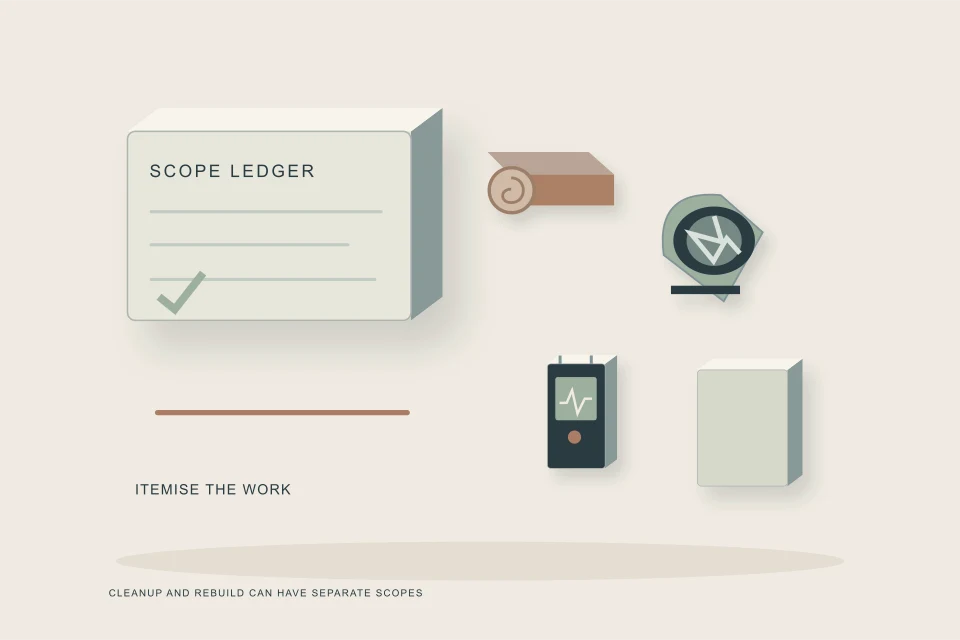
- The written description of what a contractor will do, including materials removed, equipment, days and exclusions.
- Sewer backup
- Wastewater flowing back into a building through its drains, from a blockage in the private line or an overloaded municipal sewer.
- Storm sewer
- The separate municipal system that carries rain and snowmelt from streets and roofs. In some older areas, storm and sanitary flows share one combined pipe.
- Sump pump
- A pump in a basement pit that removes groundwater collected by foundation drains. It is separate from the sanitary sewer.
- Surcharge
- When a municipal sewer runs full and under pressure, often during heavy rain, pushing sewage back toward connected buildings.
- Tide mark
- The visible stain line water leaves on walls and furniture. Water usually wicks higher inside materials than the tide mark shows.
- Trap
- The curved section of pipe under a fixture that holds a water seal to keep sewer gas out of the house.
- Wick line
- The height water has climbed inside drywall or insulation by capillary action, usually above the visible tide mark.
FAQQuestions people ask
What is the difference between black water and grey water?
Black water contains sewage and is treated as grossly contaminated; grey water comes from washers, sinks or tubs without toilet waste. Both carry germs, but black water forces removal of the porous materials it soaked.
What does mitigation mean on a restoration invoice?
Mitigation is the first phase of the job: extraction, removal of damaged materials, cleaning and drying to stop further damage. Rebuilding walls and floors is billed as a later phase.
Is a lateral the same as a sewer main?
No. The lateral is the pipe serving one building; the main is the larger municipal pipe under the street that collects flow from many laterals.
What does surcharge mean when a city talks about sewer backups?
It means the municipal sewer is running full and under pressure, usually in heavy rain or snowmelt, which can push sewage back up building connections that lack a working backwater valve.