The Sewage Cleanup Triage asks six questions: where the water came from, how much area it covered, what got wet, how long ago it happened, whether it is still backing up, and whether vulnerable people live in the home. It then says whether a careful owner cleanup may be reasonable or a restoration professional should be called, lists first steps, and names what usually has to go.
- Sewage on anything other than a small patch of hard surface points to a professional cleanup.
- A large area, more than 48 hours of wetness, or vulnerable people in the home each point to a professional on their own.
- If the line is still backing up, clearing it comes before any cleaning.
- Carpet, drywall, insulation and upholstered items touched by sewage are usually on the discard list.
- The result is general public-health-based guidance, not a site assessment; your insurer and restorer set the actual scope.
Sewage Cleanup Triage
01 /What does the Sewage Cleanup Triage decide?
The triage makes one decision: whether the mess in front of you is small enough for a careful owner cleanup or needs a restoration professional. It also gives you the first four things to do and, when the water was not clean, the materials that are normally removed rather than cleaned.
It is built around the question people actually face in a wet basement. Almost nobody needs to be told that sewage is unpleasant. What they need is a line between a puddle that a pair of gloves and a bucket of detergent can handle and a loss that needs extraction equipment, containment and days of drying. The six inputs above the result are the facts that decide that line.
| Input | Choices | Why it matters |
|---|---|---|
| What came up or leaked | Sewage (floor drain, toilet, main line); washer or sink water; clean water from a supply pipe | Sets the contamination level and whether porous materials can be dried or must go |
| How much area | A small puddle on concrete; one room; several rooms or a finished basement | Area drives equipment, labour and the chance of hidden wet material |
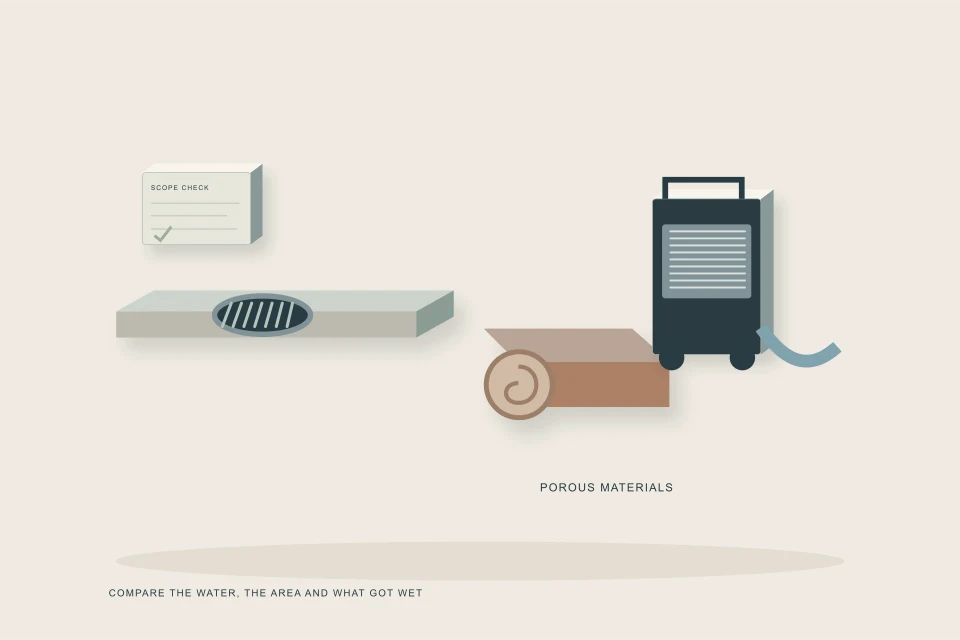
| What got wet | Carpet or underlay; drywall or insulation; upholstered furniture or boxes; concrete, tile or sealed floors only | Porous materials hold contamination; sealed surfaces can be disinfected |
| Time since it happened | Under 24 hours; 24 to 48 hours; more than 48 hours | Mould risk climbs once materials stay wet past a day or two |
| Is it still backing up? | No, the line is clear; yes, or not sure | Cleaning before the line is cleared is wasted work |
| People in the home | Young children, older adults, pregnancy, or weakened immunity | These groups should not handle sewage-contaminated material |
02 /What rules does the tool use to say “call a professional”?
The tool recommends a restoration professional when any one of four conditions is true. Otherwise it says a careful owner cleanup may be reasonable. There is no scoring and no weighting; one trigger is enough.
- The source is sewage, and it is either more than a small puddle on concrete or it touched anything other than hard, sealed surfaces.
- The area is several rooms or a finished basement, whatever the source.
- More than 48 hours have passed.
- Young children, older adults, someone pregnant or someone with weakened immunity lives in the home.
Rule 1 reflects public-health guidance. Health Canada advises that children, pregnant women and people with respiratory problems should never handle water and materials contaminated by sewage, and it tells households to contact their local public health department because more rigorous disinfection is needed. Rules 2 and 3 apply to any water, including a clean supply leak, because large areas and long wet periods create mould and structural drying problems that household fans rarely solve.
03 /What do the first steps in the result mean?
Every result lists first steps in the order they matter. When you answer that the drain is still backing up, or that you are not sure, the list starts with stopping all water use and having the line cleared.
- Clear the line if it is still backing up
Water used anywhere upstairs keeps arriving at the lowest drain. A drain or sewer contractor, or your municipality if the city side is suspected, has to restore flow before cleanup makes sense.
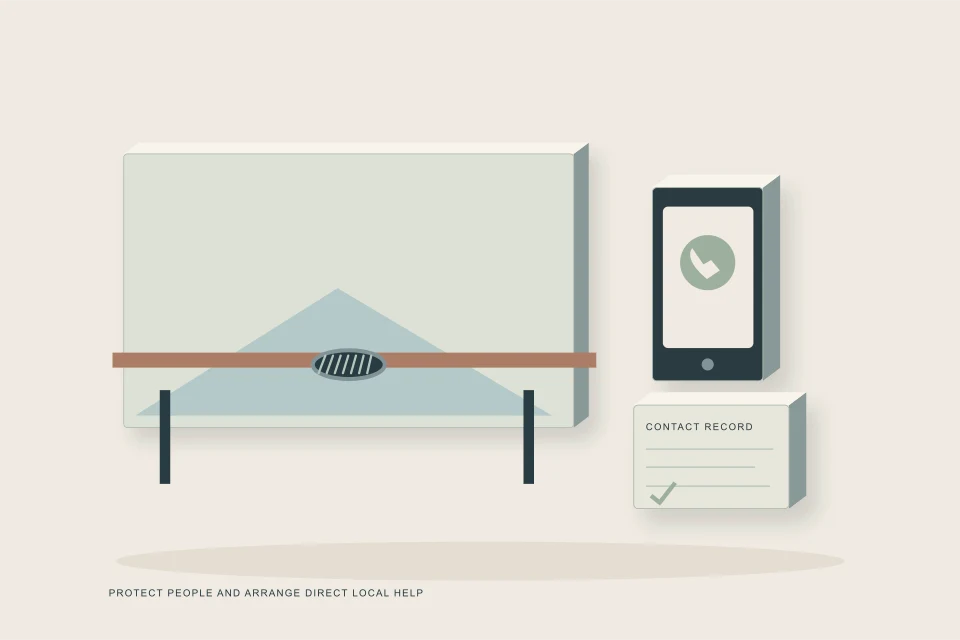
- Protect people
Keep children and pets out. Anyone who must enter wears rubber boots, waterproof gloves, eye protection and a mask rated for the work.
- Respect electricity
Do not touch electrical equipment standing in water. Switch power off at the panel only if the panel and the floor in front of it are dry.
- Photograph, then call your insurer
Record the water, the drain it came from and every damaged item before anything is moved or thrown out.
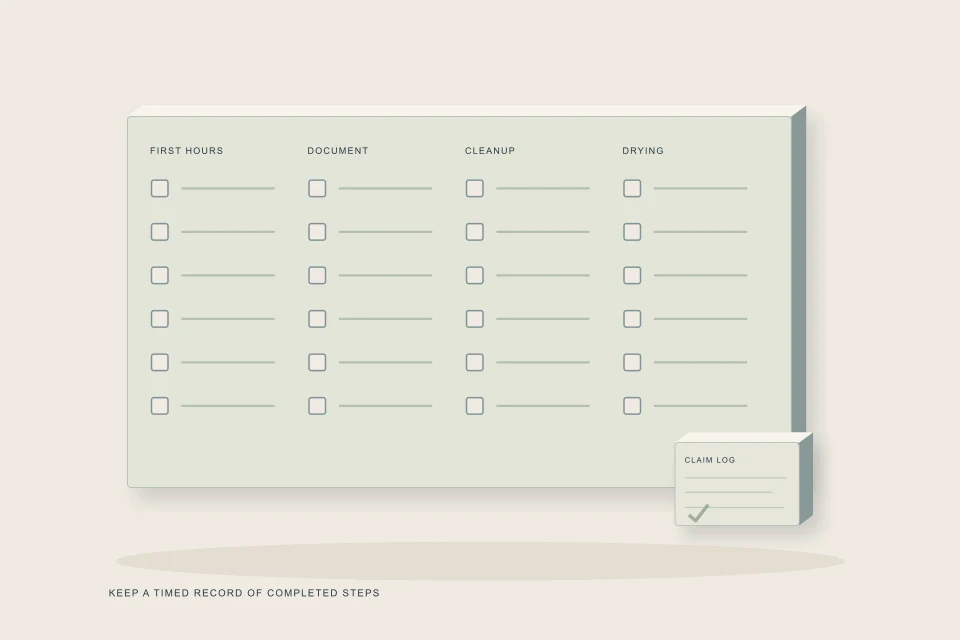
The same sequence, with more detail on each step and on who to call in which order, is in the sewage emergency guide. If you want to tick steps off and keep timestamps for a claim, use the Sewage Backup Checklist.
04 /How does the tool decide what has to go?
The “what usually has to go” list appears only when the water was sewage or washer and sink water. Clean supply water often allows materials to be dried in place, so the tool does not produce a discard list for it.
| You ticked | The tool says |
|---|---|
| Carpet or underlay | Carpet and underlay touched by sewage are normally discarded |
| Drywall or insulation | Wet drywall and insulation are cut out above the wick line |
| Upholstered furniture or boxes | Upholstered furniture, mattresses and cardboard that soaked up sewage are usually not salvageable |
| Concrete, tile or sealed floors only | No discard message; these surfaces are cleaned and disinfected |
The wick line is the height water climbed inside the wall by soaking upward, which is often above the visible tide mark. Public guidance sets cut heights above the flood line: CMHC suggests removing drywall to at least 30 cm above it, and the City of Montréal's post-flood advice says at least 50 cm. The discard guide goes item by item, including the things the tool does not ask about, such as food, medicines and children's toys.
Whenever you choose 24 to 48 hours or more than 48 hours, the result adds a mould warning. This applies to any water source, because mould follows moisture, not contamination. Health Canada says a house and its furnishings are less likely to grow mould if they are dried within 48 hours; the drying and mould guide explains how to get there.
05 /What do typical scenarios look like in the tool?
These worked cases show how the rules combine. Each row is what the tool returns for that set of answers.
| Scenario | Result | Why |
|---|---|---|
| Sewage, small puddle on concrete, hard surfaces only, under 24 h, line clear, no vulnerable people | A careful owner cleanup may be reasonable | No trigger applies |
| Sewage, small puddle, but a cardboard box soaked it up | Call a restoration professional | Sewage touched a porous item |
| Washer water, one room, carpet, under 24 h | A careful owner cleanup may be reasonable, with carpet on the discard list | Grey water in one room does not trigger on its own |
| Clean supply water, several rooms | Call a restoration professional | Large area |
| Sewage, one room, sealed floor, a toddler in the home | Call a restoration professional | Vulnerable person present |
| Any source, more than 48 hours | Call a restoration professional, plus the mould warning | Time |
Notice the third row. Washing machine water in a carpeted room does not force a professional result, but the carpet still appears on the discard list. That is deliberate: grey water can carry bacteria, and a wet carpet over concrete rarely dries fully in place. If you are unsure, err toward the stricter answer and read DIY versus professional sewage cleanup.
06 /What can the triage not tell you?
The triage is a first filter based on public-health cleanup advice. It does not see your basement, measure moisture or read your insurance policy, and it cannot override your insurer or your local public health unit.
- It does not measure hidden moisture inside walls, under flooring or in the subfloor. A restorer's meter does.
- It does not know your coverage. Some insurers want to approve the contractor or see the damage first.
- It does not diagnose why the backup happened. A camera inspection after the line is cleared does that.
- It does not account for asbestos-era materials. In older homes, disturbing some flooring, plaster or insulation needs testing first.
- It does not store your answers or send them anywhere.
For planning money, the sewage cleanup cost guide gives 2026 ranges by scope. When the result says professional, you can describe the job and attach photos.
FAQQuestions people ask
Why does the triage say professional for a small sewage spill on carpet?
Because sewage reached a porous material. Carpet and underlay hold contamination that cleaning cannot reliably remove, so removal and disinfection of the floor beneath is normally needed.
Does washing machine water count as sewage in the tool?
No. The tool treats it as grey water: carpet, drywall and soft items still appear on the discard list, but grey water alone does not force a professional result unless another trigger applies.
Why does time matter if the water is gone?
Materials stay wet long after the puddle is gone. Past 24 to 48 hours, mould becomes likely on anything still damp, which is why the tool adds a warning and treats 48 hours as a trigger.
Who counts as vulnerable in the triage?
Young children, older adults, anyone pregnant and anyone with weakened immunity. Public-health guidance says these people should not handle sewage-contaminated water or materials.
Can the triage replace an adjuster's decision?
No. It is a general guide. Your insurer and the restoration company decide the actual scope, and your local public health unit's advice takes precedence.
NETWORKGo deeper across the HAUSE Sewer network
Sewer backup: what to do in the first hour
What to do in the first hour of a sewer backup: electrical safety, stopping water use, calling a sewer cleaner, insurance photos, health and cleanup.
PipeCleaning.caPipe Method Matcher: which cleaning methods suit your pipe
Pipe Method Matcher: enter your house era, pipe material and symptom to see which pipe cleaning methods are recommended, safe with conditions, or avoid.
DrainAugering.caHow often should you snake your drains and main sewer line?
How often should you snake your drains or main sewer line? Why healthy lines need none, how to set an interval from your clog history, and when to repair instead.