After a sewage backup, remove soaked materials, clean and disinfect, then dry the structure as fast as possible. Health Canada says homes and furnishings dried within 48 hours are less likely to grow mould. Use dehumidifiers and air movers once the power is safe, keep indoor humidity between 30 and 50 per cent, and confirm dryness with moisture readings, not touch.
- The 48-hour window is the benchmark: wet materials dried within it are much less likely to grow mould.
- Remove wet porous materials first; you cannot dry sewage-soaked drywall or carpet in place.
- Dehumidifiers do most of the work in a basement; open windows help only when outdoor air is drier.
- Health Canada recommends indoor relative humidity between 30 and 50 per cent.
- Mould larger than about 3 square metres is a job for professionals under Health Canada's guidance.
01 /Why does drying speed matter so much after a sewage backup?
Drying speed matters because mould starts on damp materials within a day or two, and once it grows, the cleanup gets bigger, slower and more expensive. Health Canada's flood cleanup guidance says a house and its furnishings are less likely to grow mould if they are dried within 48 hours. The Government of Canada's Get Prepared site gives the same timeframe for cleaning up after a flood.
| Time since the backup | What is happening | Priority |
|---|---|---|
| First hours | Sewage sits on floors and wicks into drywall, carpet and insulation | Stop the water, clear the line, record the damage |
| Day 1 | Moisture spreads upward and outward inside materials | Extract, remove soaked materials, clean and disinfect |
| Day 2 | The 48-hour benchmark approaches | Drying equipment running, readings taken |
| Days 3 to 7 | Anything still wet is at high risk of mould growth | Keep drying until readings reach normal |
| After a week or more | Mould and persistent odour are likely where drying failed | Find hidden moisture; remediate any growth |
Sewage adds a second reason for speed: wet, contaminated material keeps producing odour and supporting germs until it is removed and the space is dry. Drying is the step that makes the cleaning and disinfection last.
02 /Should you remove materials before drying?
Yes. With sewage, soaked porous materials are removed before drying starts, because drying them in place would leave contamination behind. That means carpet and underlay, the lower drywall, wet insulation and particleboard come out first, which also opens the wall cavities so air can reach the framing.
Removal also changes how fast the rest of the structure dries. A stud wall with its lower drywall and insulation gone dries in days; the same wall left closed can stay wet inside for weeks while the paint on the outside looks fine. Opening cavities, lifting flooring and pulling baseboards gives the air something to work on.
CMHC's flood guidance is that materials that cannot be dried within 48 hours should be discarded, and it lists drywall to at least 30 cm above the flood line among the items to remove. The full list is in what to throw away after a sewage backup, and the clean-then-disinfect method is in disinfecting after a sewage backup.
03 /How do you dry a basement after a sewage backup?
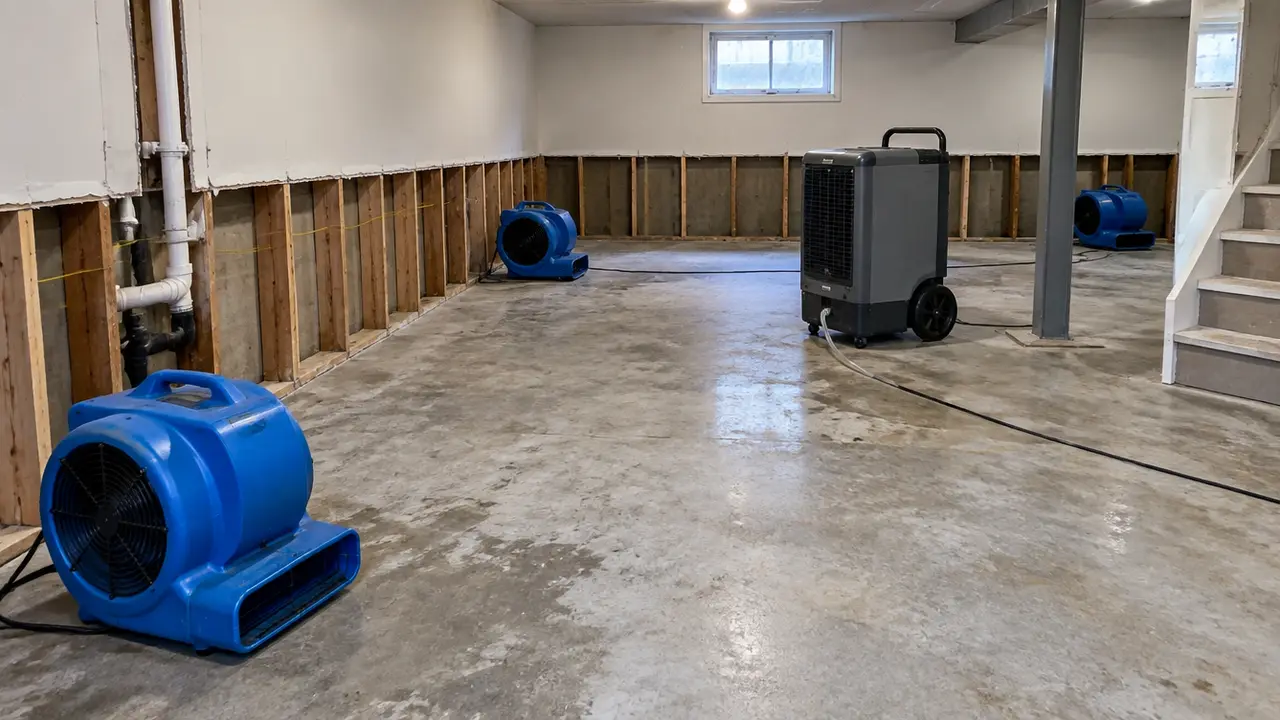
Dry a basement with dehumidifiers and moving air, running continuously, while keeping the space closed to humid outdoor air. Health Canada suggests ventilating with open windows and fans when the weather allows low humidity, or using dehumidifiers. In most Canadian basements, dehumidifiers do the heavy lifting.
- Confirm the power is safe
An electrician or the utility should confirm it before any equipment is plugged in near where water was.
- Place dehumidifiers centrally
Empty or drain them continuously; a full bucket stops a machine.
- Move air across wet surfaces
Fans or air movers aimed along walls and floors speed evaporation.
- Keep heat moderate
Warm air holds more moisture for the dehumidifier to remove; very cold basements dry slowly.
- Open windows only when outdoor air is drier
On humid or rainy days, opening windows adds moisture.
- Check readings daily
Compare wet areas with a dry reference area of the same material until they match.
04 /How do you know when the basement is really dry?
You know it is dry when moisture readings in the affected materials match readings in the same materials in an unaffected area. Touch and appearance are unreliable; drywall and framing can feel dry on the surface while holding water inside.
| What to check | How | Target |
|---|---|---|
| Framing and bottom plates | Pin moisture meter | Similar to dry framing elsewhere in the house |
| Concrete slab | Meter reading or taped plastic sheet test | No darkening or condensation under the sheet after a day |
| Remaining drywall above the cut | Non-invasive meter | Matches a dry wall in another room |
| Indoor air | Hygrometer | Relative humidity between 30 and 50 per cent |
| Odour | Your nose, a day after equipment is off | No musty or sewage smell |
Health Canada recommends keeping indoor relative humidity between 30 and 50 per cent. Do not close walls or lay new flooring until the readings are right; trapping moisture behind new drywall is the most common cause of mould after a flood repair.
05 /What if mould has already started?
If mould has already appeared, its size decides who should clean it. Health Canada's guidance treats up to three patches, each smaller than a square metre, as small, and a larger area up to about 3 square metres as moderate; both can be cleaned by an occupant with protection. An extensive area over about 3 square metres calls for a professional.
- Clean mould with water and unscented dish detergent; Health Canada says there is no need to use bleach.
- Wear safety glasses or goggles, a disposable N95 respirator and household gloves.
- Use a HEPA vacuum on the area before and after cleaning.
- Keep children, seniors and people with asthma or severe allergies away from the room during mould cleanup.
- Remove and replace mouldy porous materials rather than trying to clean them.
- Fix the moisture source; mould returns wherever materials stay damp.
In a sewage loss, mould usually means drying was delayed or wet material was missed. Look behind remaining drywall, under stairs, inside cabinet bases and under floating floors.
06 /How long does drying usually take, and what does it cost?
Drying commonly takes several days once soaked materials are out, and longer in cold, humid or heavily finished basements. A concrete slab with a thick layer of sludge, or a wall that was left closed, can take a week or more.
Drying equipment is billed per machine per day in many professional quotes, which is why the number of equipment days on a quote deserves a question. As a 2026 planning estimate, professional cleanup of one finished room, drying included, plans at about $3,000 to $10,000; the sewage cleanup cost guide has the full ranges.
Local climate changes the drying approach; the Vancouver guide explains why coastal humidity favours dehumidifiers over open windows. For choosing and supervising a drying contractor, see working with a restoration company, or send a request with photos.
FAQQuestions people ask
Can a basement dry on its own after sewage cleanup?
Rarely within the 48-hour window. Closed basements hold humid air; without dehumidifiers and air movement, wet framing and concrete stay damp long enough for mould to start.
Should I run the furnace to dry the basement?
Only after a qualified technician has checked it if water reached it. Moderate heat helps dehumidifiers work, but a flooded furnace can be a hazard.
What humidity should my basement be at after a flood?
Health Canada recommends indoor relative humidity between 30 and 50 per cent. A simple hygrometer shows where you are.
When can I put drywall back after a sewage backup?
Once moisture readings in the framing and slab match unaffected areas and the cavity has been cleaned and disinfected. Closing walls early traps moisture.
Is a musty smell after drying a sign of mould?
Often. A musty or earthy smell after the equipment is gone usually means moisture remains somewhere, with mould starting. Take readings behind baseboards, under flooring and inside cabinet bases.
Does mould always grow after a sewage backup?
No. Prompt removal of soaked materials and drying within about 48 hours make mould much less likely, according to Health Canada.
NETWORKGo deeper across the HAUSE Sewer network
How to clean up after a sewer backup in the basement
How to clean a sewer backup in a basement: when to do it yourself, gear you need, removing soaked materials, cleaning, disinfecting, drying and rebuilding.
DrainAugering.caSnaking a drain from the roof vent: when it helps and when it does not
Can you snake a drain from the roof vent? When the vent stack is the right access, clearing a blocked or frost-closed vent, and the roof safety that comes first.
PipeCleaning.caPipe cleaning methods compared, method by method
Pipe cleaning methods compared: snaking, hydro jetting, descaling, chain knockers, enzymes and chemicals — what each removes, and which pipes each can harm.